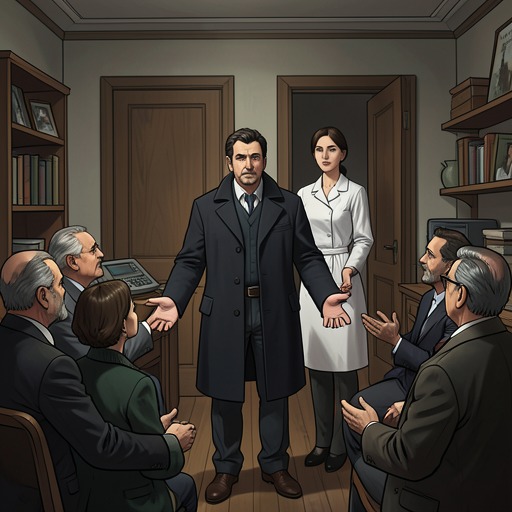
Lorians
The Robot Who Looked Like MeThe Lorians are the humanoid inhabitants of Loris, a society that seems to embody human ideals of abundance, peace, and self-government. Their civilization’s apparent perfection is not simply a spectacle for Johnny Bezique: it becomes the basis of a political dilemma. The Lorians understand that their stable, trusting culture may be unable to withstand Earth’s aggression, and respond not by preparing to conquer or destroy humanity, but by offering Bezique authority over them.
Identity and Society
Loris presents an improbable likeness to Earth: its air is breathable, its water drinkable, and its people humanoid, despite Nobel Prize winner Serge Von Blut’s calculation that such a combination was extraordinarily unlikely, at odds of 1093 to one. The novel quickly shifts attention from this coincidence to the society the Lorians have built. They are described as pleasant, comely, inventive, and progressive, with a stability that has lasted for centuries rather than resting on a recent or fragile truce.
For five hundred years, the Lorians have had no wars, rebellions, or insurrections, and none appears imminent. Their birth and death rates are stable; the population has room and opportunity, and several races coexist without racial problems. The society’s peacefulness is therefore linked to material and demographic conditions as well as temperament. The account depicts neither scarcity-driven competition nor social conflict as an unavoidable feature of collective life.
The Lorians combine advanced technology with ecological balance. Individual work is creative and freely chosen, while self-regulating machines perform brute labor. The contrast matters: technology has not merely increased productive power but has removed the need to assign people degrading work, leaving individuals to choose their own contribution. The account offers this arrangement as part of a wider social equilibrium, not as an isolated mechanical convenience.
A City of Abundance
The capital, Athisse, gives the society’s principles an architectural and everyday form. It is a vast city of enormous, beautiful public buildings—castles, palaces, and other structures distinguished by bold asymmetry. Its amenities range from bazaars and restaurants to parks, statues, graveyards, funparks, hot-dog stands, playgrounds, and a river. Public magnificence and ordinary recreation occupy the same landscape; the city is not presented as a ceremonial center reserved for rulers.
Food, clothing, housing, and entertainment are free. Residents take what they want and give what they want, and the exchange balances without money. With no money, there is no need for banks, treasuries, vaults, or safe-deposit boxes; with no such need, even locks are unnecessary. Athisse’s doors open and close by mental command. This detail extends the account’s portrait of trust into the physical environment: security is not shown as a system of barriers but as something the society has made unnecessary.
The arrangement is presented as a functioning social order rather than a promise of future reform. Athisse contains homes, public spaces, places of entertainment, and the necessities of life, while its residents retain freedom to choose work and exchange. The city’s abundance does not erase organization; it changes what organization must do. In particular, the absence of money and locks suggests that the familiar apparatus of possession and protection has no corresponding role in Lorian life.
Government Without Command
Lorian government reflects the near-unanimous collective mind of the people. Between public desire and government action, the narrative identifies no discernible distortion, gap, or delay. As Johnny learns more about Loris, even the word government begins to seem excessive: the society appears to have almost none, and what it has governs largely by not governing.
The closest figure to a ruler is Veerhe, Chief of the Office of Future Projections. Yet Veerhe issues forecasts rather than orders, offering economic, social, and scientific projections from time to time. His position exemplifies the difference between anticipating collective needs and directing people by command. Lorian political life does not appear to depend on a sovereign who imposes a will at odds with the population’s own; public intention and official action already coincide.
That arrangement is a strength within Lorian society and a vulnerability in its dealings with Earth. The Lorians are straightforward, stable, reasonable, and trusting, while Veerhe describes Terrans as aggressive, unbalanced, and capable of deviousness. He predicts not a simple technological assault but a drawn-out conflict of discussions, treaties, violations, renewed discussions, aggressions, explanations, encroachments, and clashes. Earth cannot simply ignore the Lorians, and the Lorians, in turn, cannot refuse cooperation in seeking reasonable solutions. Their willingness to engage is precisely what Veerhe fears may be used against them.
Johnny Bezique and the Human Threat
The Lorians introduce Johnny to their language through hypnopaedic instruction and show him around Athisse. His guide, Helmis, is close to Johnny’s age and displays wit, patience, sagacity, gentleness, humor, insight, and self-deprecation. Johnny comes to detest him immeasurably. The comic disproportion between Helmis’s virtues and Johnny’s response makes the encounter an early measure of Johnny’s discomfort: he is not merely comparing two cities or technologies, but facing a society whose qualities unsettle his expectations.
After only a few days, Johnny concludes that the Lorians approach the human ideal of perfection. He recognizes them as genuinely fine people and paragons of virtue, but this judgment does not remove what the narrative calls Earth’s standard nightmare. Humans, in their perversity, do not want aliens to govern them, even when the aliens are exceptionally good and act for Earth’s benefit. Lorian virtue cannot itself overcome the political force of human resistance to alien rule.
Veerhe’s forecast makes that mismatch explicit. From a purely technological standpoint, the Lorians could destroy anything Earth sent against them. But technological superiority does not settle the conflict, because neither side can avoid the psychological and political contest that follows first contact. The Lorians expect Terrans to be sufficiently advanced not to throw themselves blindly against a stronger force, and sufficiently aggressive to pursue advantage through prolonged dealings. Their prediction is that Earth will eventually take them over—not because the Lorians lack the power to resist in a direct battle, but because they may be unable to act with the ruthlessness required to prevent a gradual defeat.
The Offer of Rule
Johnny recognizes the imbalance in desire: Earth wants victory more intensely than the Lorians do. He tells Veerhe that the Lorians will play by the rules even in life-and-death contests, while Terrans will stop at nothing to win. Veerhe confirms that this is also the Lorians’ extrapolation. Their response is startlingly consistent with their political character: rather than issue commands to transform themselves into a more aggressive people, they propose saving time and trouble by putting Johnny in charge. They want him to rule them.
The offer is both a practical concession and the culmination of the contrast between the two societies. The Lorians’ forecasts have led them to anticipate their own subjection, yet their answer is to make the transfer of power explicit and cooperative. A society built on trust and collective agreement entrusts its future to a representative of the people it fears will exploit that trust. The Lorians’ near-perfection therefore carries a sharp paradox: their reasonableness lets them see the danger clearly, but seeing it does not make them willing or able to meet it on Earth’s terms.